
Your D2C Brand Already Automates WhatsApp. So Why Is Your Support Team Still Growing?
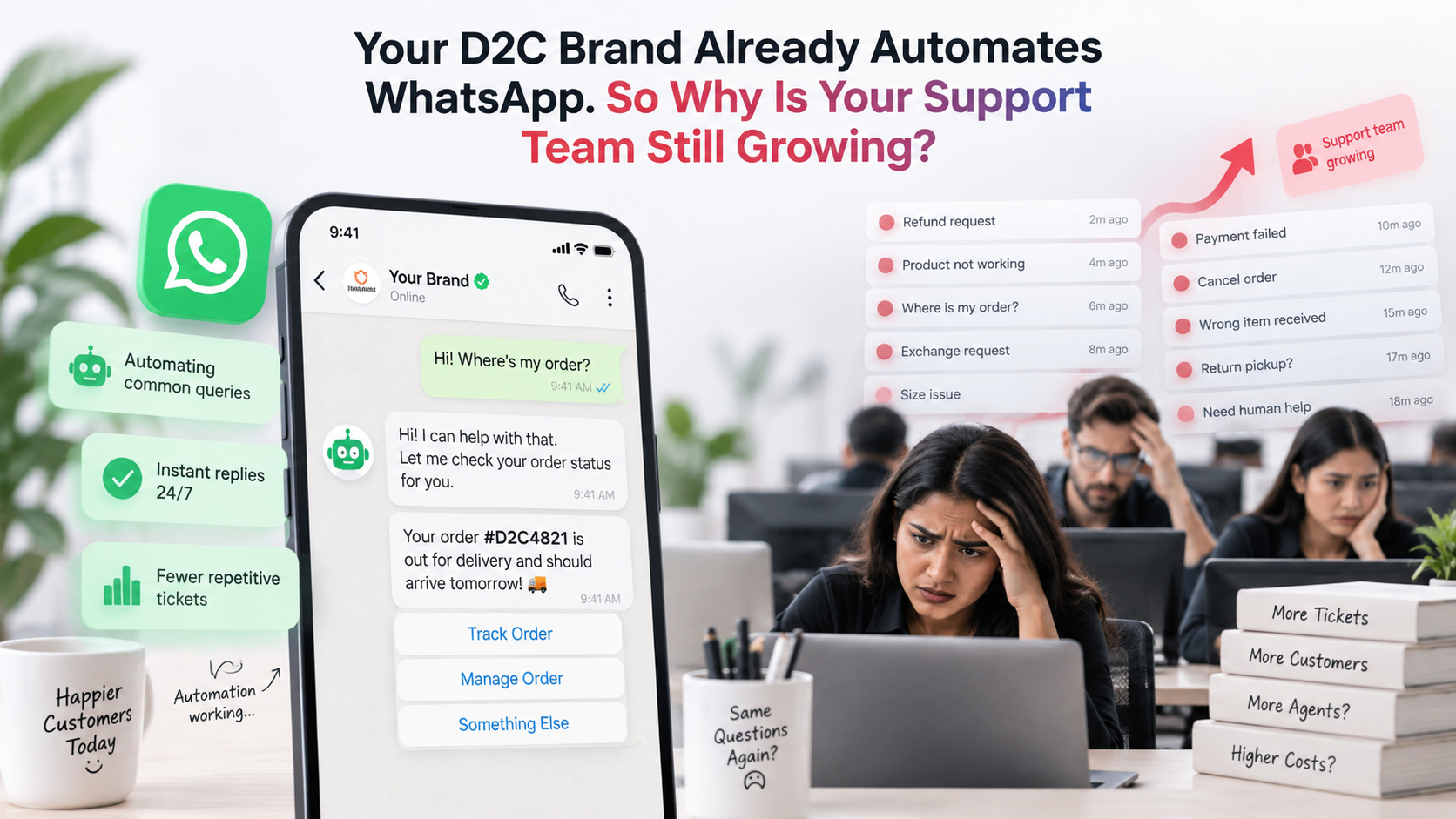
Most growing brands already use templates, bots, notifications or shared inboxes. The next efficiency problem isn't sending more automated replies. It's reducing the customer requests that still require someone to open another system and do the work manually.
Too Long? Read This First
- Most established D2C brands already automate greetings, notifications, FAQs and repetitive WhatsApp journeys. The remaining cost is increasingly hidden in requests that automation captures but does not resolve.
- A customer interaction is not truly automated if an agent still has to open Shopify, OMS, logistics, CRM or another system to complete it.
- The useful metric is therefore not simply automation rate. Track resolution rate, escalation rate, manual touches per conversation and actions completed without human intervention.
- The next automation opportunity usually sits between the conversation layer and your operational systems—not in adding another set of templates.
- The objective isn't to remove humans from customer experience. It is to reserve human attention for exceptions, judgment and high-value conversations.
Table of Contents
- WhatsApp Automation Isn't New Anymore
- The Automation Illusion
- Why Automated Conversations Still Reach Humans
- The Four Levels of Customer Automation
- Measure Resolution, Not Replies
- Where D2C Automation Usually Breaks
- A Real Customer Journey Example
- How to Audit Your Current Automation
- What Should AI Actually Do?
- When Humans Should Stay in Control
- Moving From Conversation Automation to Business Automation
- FAQ
WhatsApp Automation Isn't New Anymore
If you operate a growing D2C brand, chances are you aren't handling every customer conversation manually.
Your stack may already send order confirmations automatically.
Shipping updates go out without an agent.
COD orders may trigger confirmation workflows.
Customers asking common questions might receive menu-based responses.
Your support team may work from a shared inbox instead of personal phones.
And basic queries may already be handled using keywords, templates or a chatbot.
So the interesting question in 2026 isn't:
“Should a D2C brand automate WhatsApp?”
For many established brands, that decision was made years ago.
The more useful question is:
“After everything we've already automated, why does customer-support workload continue to grow?”
The answer often lies in the difference between automating a conversation and resolving the customer's actual request.
The Automation Illusion
Imagine a customer messages:
“Where is my order?”
Your system immediately replies:
“Please share your order number.”
The customer provides it.
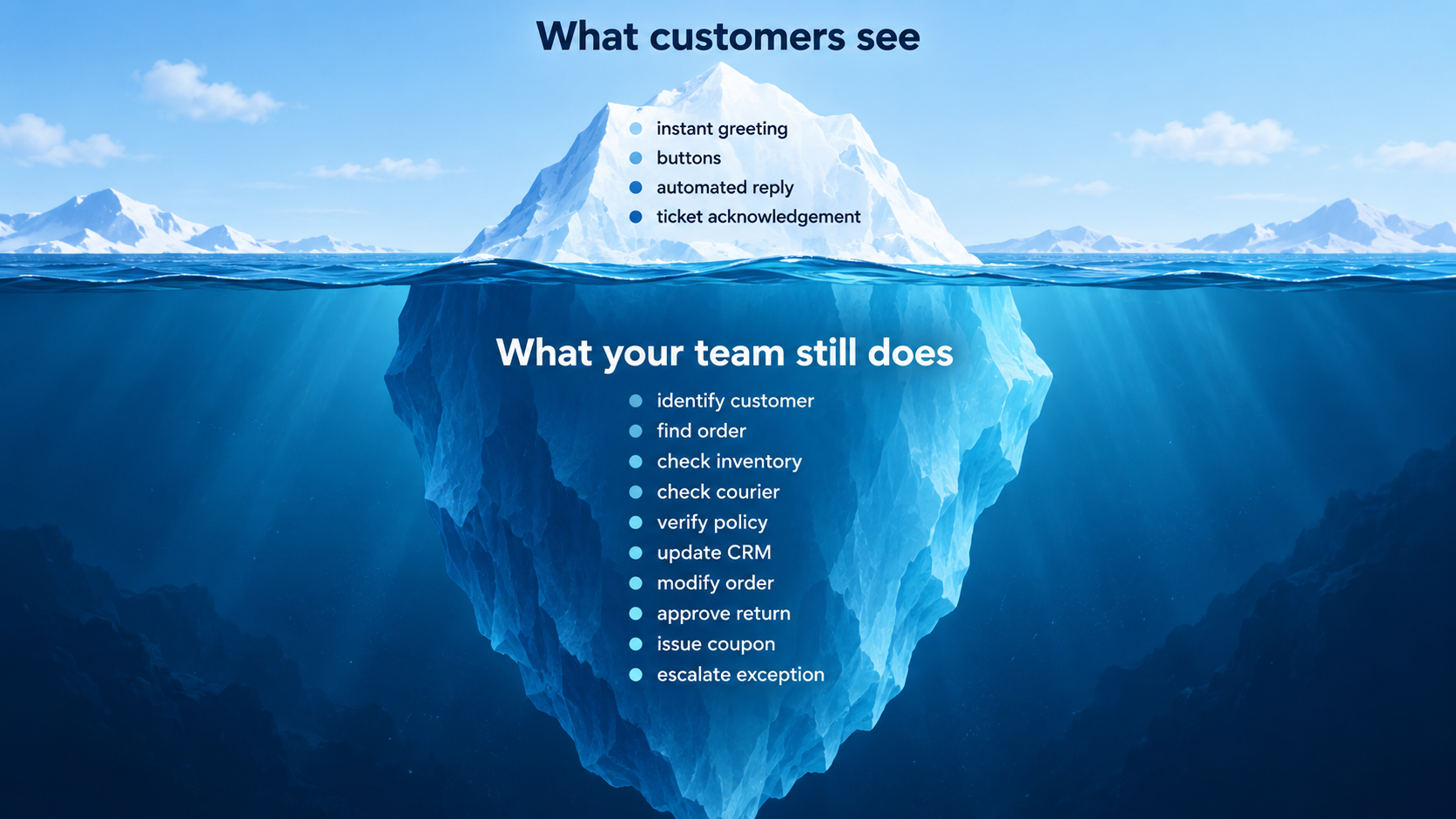
The workflow creates a ticket.
An agent opens the ticket.
They then open the ecommerce backend.
Search for the order.
Open the courier dashboard.
Check the latest tracking event.
Return to the support inbox.
Type the answer.
From the customer's perspective, part of the interaction was automated.
From the company's perspective, most of the work was not.
This is the automation illusion.
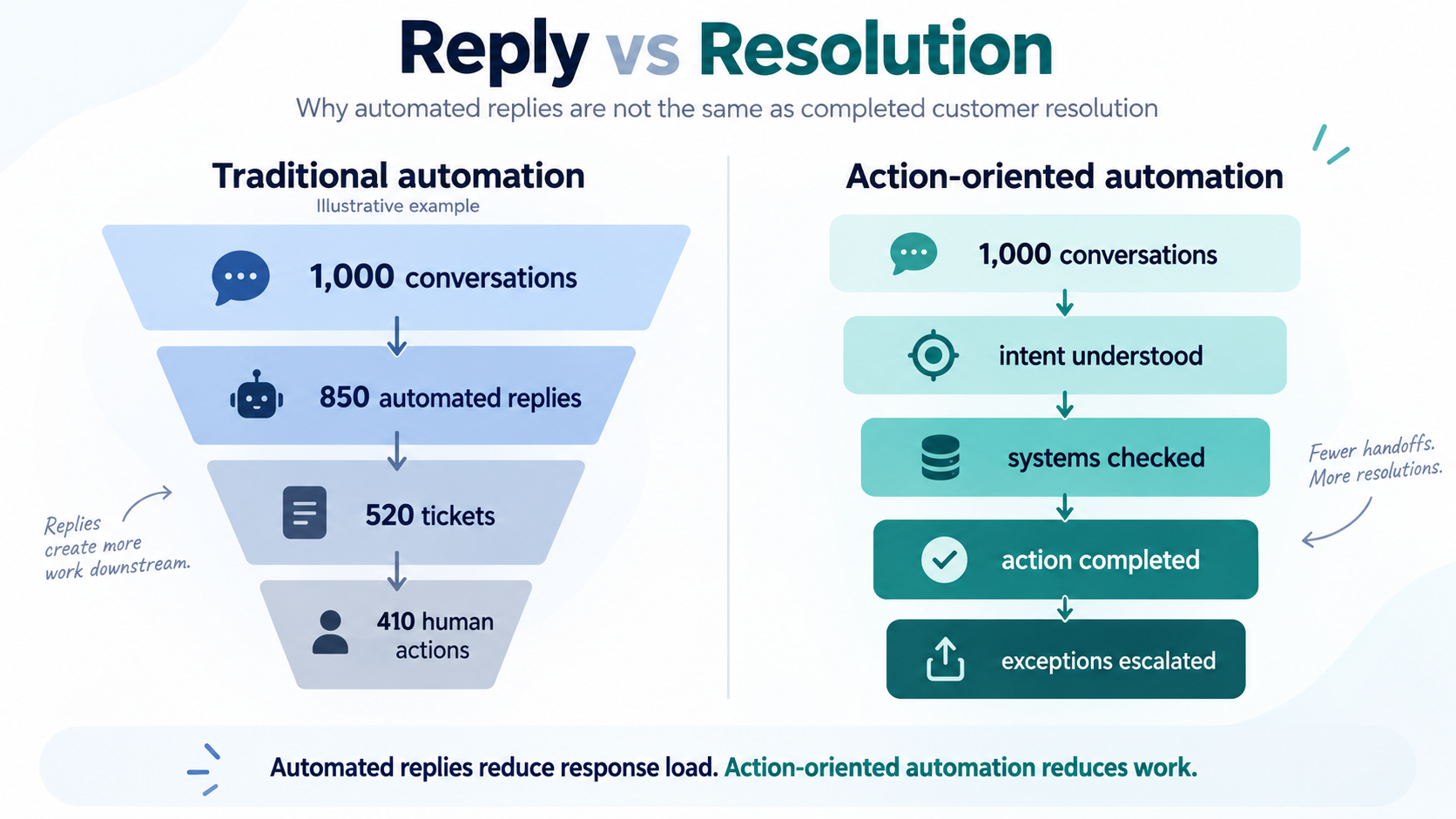
A workflow can reduce response time without reducing work performed by the team.That distinction matters enormously once a brand reaches meaningful scale.
Measure Resolution, Not Replies
This is another place where Shopap content can differentiate.
Most marketing material talks about:
response rate
response time
automation rate
number of conversations automated
Those numbers are useful.
But mature CX teams should increasingly ask another question:
Did the customer's problem actually get resolved without human work?
Suppose an AI answers 80% of incoming messages.
Sounds excellent.
But if half of those conversations eventually become tickets because the AI cannot:
- retrieve the correct order
- check inventory
- modify an address
- initiate an exchange
- update an order
- check delivery exceptions
- capture a sales opportunity
then “80% automated” doesn't tell you much about operational efficiency.
I would introduce four metrics here.
| Metric | What it actually tells you |
|---|---|
| Response automation rate | How many messages receive an automated response |
| Resolution rate | How many customer needs are completed without human intervention |
| Escalation rate | How many automated conversations eventually require an agent |
| Manual touches per conversation | How much human work remains behind the automation |
Where D2C Automation Usually Breaks
Lets walk through the actual journeys a sophisticated D2C company deals with.
Where is my order?
Easy only if the system can access live order and logistics information.
Do you have the same kurta in XL?
Easy only if the system understands the product and sees current variant inventory.
Change my delivery address.
Now you're dealing with an action and fulfilment status.
I want to exchange M for L.
Now you need order history, return policy, inventory and perhaps reverse logistics.
Can I use this serum with retinol?
Now product knowledge and safety boundaries matter.
Send me the same order as last month.
Now identity, purchase history, catalogue and ordering all meet inside one conversation.
This is where template-based automation reaches its natural limit.
Consider a D2C fashion brand processing 30,000 orders per month
The company already uses:
Shopify
a logistics platform
WhatsApp automation
a helpdesk
eight customer-support agents.
They are not “manual.”
Order confirmation is automated.
Shipping alerts are automated.
Basic FAQs are automated.
Yet agents still spend significant time on requests such as:
“Where's my parcel?”
“Change my size.”
“Update my phone number.”
“Can you deliver before Saturday?”
“I received the wrong colour.”
“Cancel one item but keep the other.”
The problem isn't absence of automation.
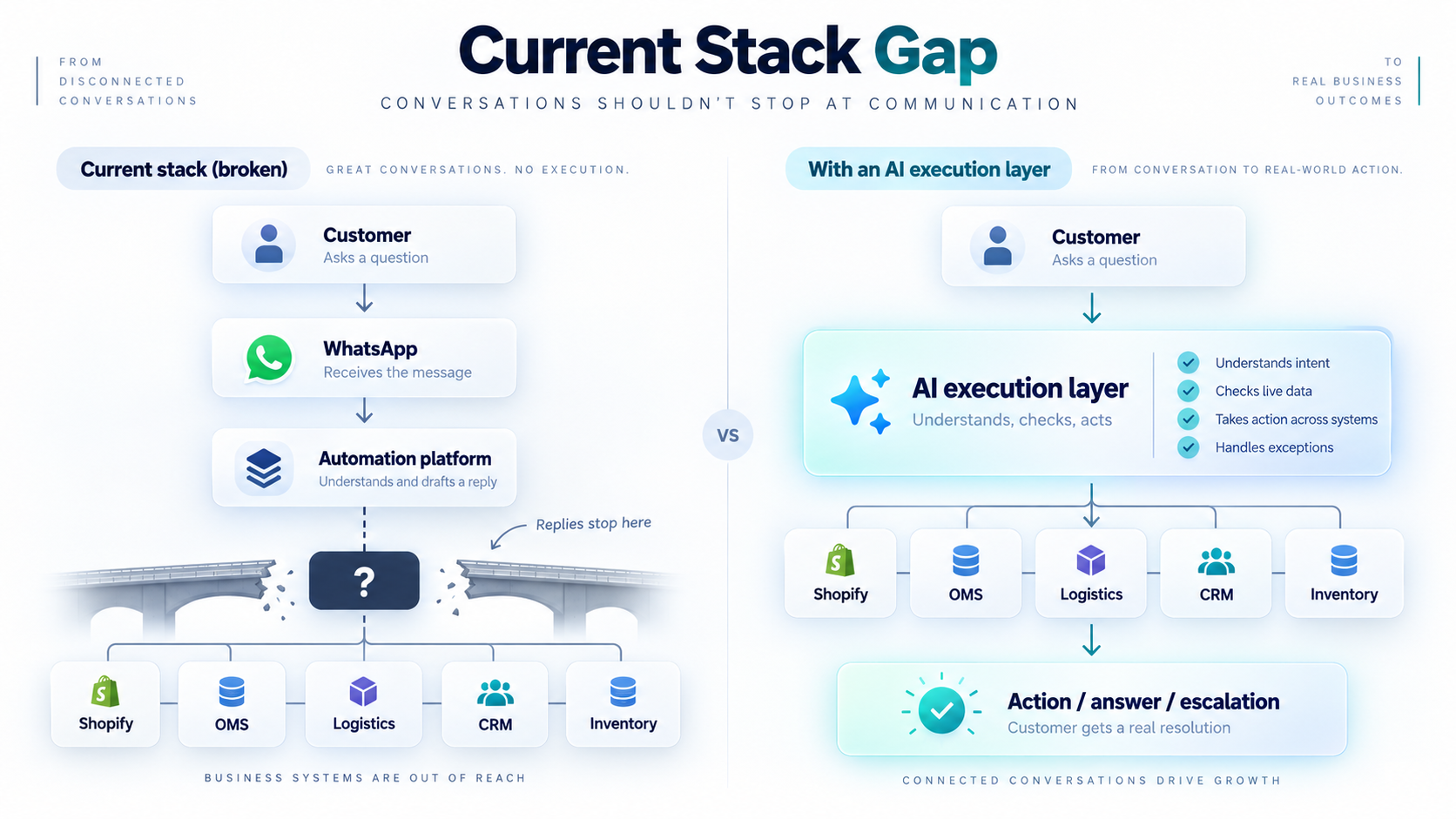
The problem is that the automation ends exactly where operational context begins.
Run this 30-minute audit on your support operation
Take the last 100–200 customer conversations.
For each one, ask:
1. Did automation respond?
Yes / No
2. Did automation resolve the request?
Yes / No
3. Did a human eventually enter the conversation?
Yes / No
4. What did the human actually do?
- retrieve information
- apply judgment
- perform an action
- approve an exception
- calm/reassure customer
5. Which systems did they open?
Shopify
OMS
courier portal
CRM
inventory
payments
other
6. Could the action safely have happened automatically?
Yes
Yes, with approval
No
Then calculate:
True resolution rate
conversations resolved without human intervention / total conversations
and:
Human dependency rate
automated conversations later requiring human intervention / automated conversations
Where AI actually belongs
Only after all this do we talk about AI.
Not:
“AI can answer customers 24×7.”
Instead:
AI becomes particularly useful where customer requests are:
unstructured + contextual + dependent on business data.
For example:
“The blue shirt from yesterday's order hasn't shipped yet. If XL isn't available, send black instead.”
A rigid workflow struggles because the customer isn't following a predefined journey.
A useful AI system has to determine:
who → which order → which item → fulfilment status → inventory → permissible action → next step
Not every resolution should be autonomous
Cases involving:
- high-value refunds
- safety complaints
- fraud
- policy exceptions
- angry VIP customers
- ambiguous product advice
- unusual financial actions
may need human approval or complete human ownership.
The goal shouldn't be:
100% automation.
The goal should be:
The highest safe resolution rate with the lowest unnecessary human effort.
Moving From Conversation Automation to Business Automation
Most brands already have a communication layer.
What remains is connecting conversations with the systems that actually run the business.
That's the problem Shopap is working on.
Instead of only generating a reply, Shopap is designed around a cycle of:
understand → retrieve context → decide → take permitted action → escalate when needed
across business systems such as catalogue, inventory, customers and orders.
Take 100 recent customer conversations and identify:
what automation already handles, what humans still do, and what could safely move from reply automation to resolution automation.
If that exercise reveals a meaningful gap, that's the conversation worth having.
Audit Your Customer Conversations With Shopap